Identity-bound access across any network — your keys, your infra, and proof the vendor was never on your data path.
Each solution retires one kind of static credential — replaced by identity bound to the device, with an expiry and a ledger entry. Five doors, one mesh, two ways in. One honest choice among several, not the answer.
An engineer, a repo, an agent of your own. Mostly live and self-serve — start where it bites.
Every run gets a minutes-long identity and leaves a signed receipt — which run, which repo, which scope. Nothing static for a leak to find.
Read more →No static key, no bastion, no public port. Device identity in, root as a grant that expires in minutes, every session in your ledger. Even from your phone.
Read more →Scoped, expiring identity for a script or an AI agent — an actor in your ledger, zero secret left behind. An early, honest take on the coming wave.
Read more →The budget-owner's view: the network, and identity across the whole organization.
Services carry private names only your mesh resolves. No public gateway to exploit, no flat network to cross, no vendor cloud on the path.
Read more →The enrolled device is the key: nothing to steal, share, or reset. Offboarding is revoking one identity — built for field forces and frontline teams.
Read more →Compose, not replace — secure what you choose, leave the rest untouched.
Ankayma layers a sovereign zero-trust path on top of what you already run — you choose what joins the mesh; everything else stays exactly as it is.
Your DB replication and engine-native TLS stay off the mesh — prod-critical, not dependent on Ankayma. Unchanged.
NoKey SSH and admin access join the mesh — identity-bound, default-deny, every session in your ledger.
No app-by-app migration, no 3–6 month cutover. Running side-by-side isn't a phase you endure — it's how Ankayma is built. Full architecture →
The mesh agent, CLI, and the app are open source on GitHub. Read every line before you install — review the code, build it yourself, and audit exactly what runs on your infrastructure. Releases are Cosign-signed, so you can verify what you run matches what we published. We keep it open because trust should be verifiable, not asked for.
Review the source on GitHub →Today that answer comes from the vendor. Their logs, their attestation, their word. Every link in the evidence chain starts with the party being assessed.
The Enterprise line is the same architecture with one thing added that only matters at organizational scale: a record of who reached what, held by you.
Demo, UAT, and production need different tools — one of them isn't ours.
Read more → What the ledger recordsAnd what it deliberately doesn't.
Read more → Sovereignty & dependencyWhat sits where, what happens if we go away.
Read more →A separate product line — moving from Personal is a guided onboarding, not an in-app upgrade. We're onboarding design partners now; not generally available yet.
A client opens your demo themselves — no VPN, no public link — and you can prove the vendor never saw it.
Four steps, under five minutes. Full guide →
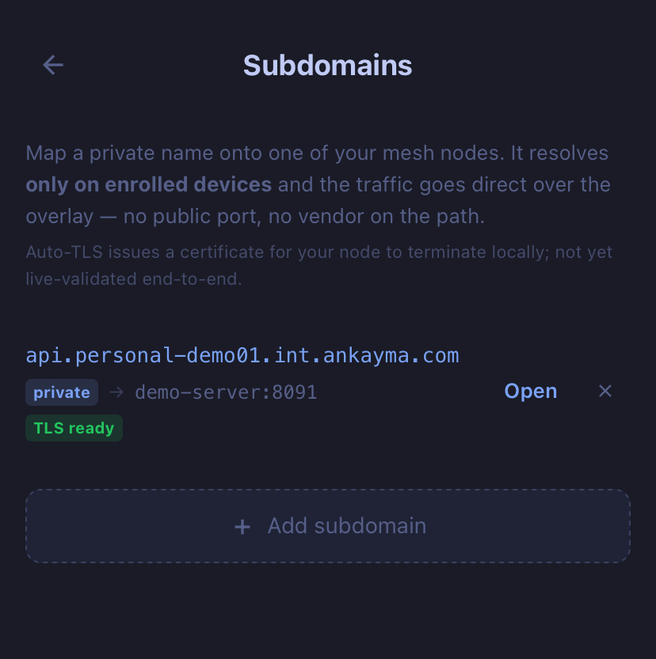
At organizational scale, this is lane 1 of vendor access — the environment your vendors use to demo and preview the software they're building for you. See the three lanes →
No commitment. Self-serve. Cancel anytime.
Made for individuals and small teams — pin each project to its own private domain, invite a client's device into your mesh, and they open it themselves. Five projects in parallel on Free.
Sign up with GitHub · No credit card · Cancel anytime
Send a peer your link. When they actually get going, you both get extra months on us — the more of your team and community run sovereign, the stronger everyone's mesh. No cash, no catch, no selling.
Rewards are account credit (extra months), granted as we go while we finish the self-serve version. Actively selling to customers is a different lane — that's Partners.